
Search Asheboro Voter Registration
The official starting point for one person is the NCSBE Voter Search. It is free and covers voters statewide. For an Asheboro search, enter the last name first and select Randolph County. Add a first name or year of birth only when the result list is broad. This keeps the search narrow without treating a full birth date as public data. The result can confirm current status, precinct, districts, polling place, party affiliation, and recorded participation history.
| Field label | Type | Required | Options / format |
|---|---|---|---|
| First Name | Text | No / strongly identifying | Partial entry is supported by interface behavior; verify live. |
| Last Name | Text | Yes | Surname search. |
| Year of Birth | Dropdown / text | No | Used to narrow; full date of birth is not public. |
| County | Dropdown | No | Select RANDOLPH to localize. |
| Voter Status | Dropdown | No | Active, inactive, and removed or denied options as the live portal provides. |
| Search | Button | Not applicable | Executes the search. |
| Clear / Reset | Button | Not applicable | Clears the criteria. |
Read the result as a dated view. An Asheboro precinct, district, party, address, or status may change after the lookup. Save the date of access when using a result for family research or civic work. If the name does not appear, try fewer fields before assuming there is no record. The county counter can check the current system and explain district assignments that the public form does not resolve.
The official voter lookup screen shows the fields used for a focused search.
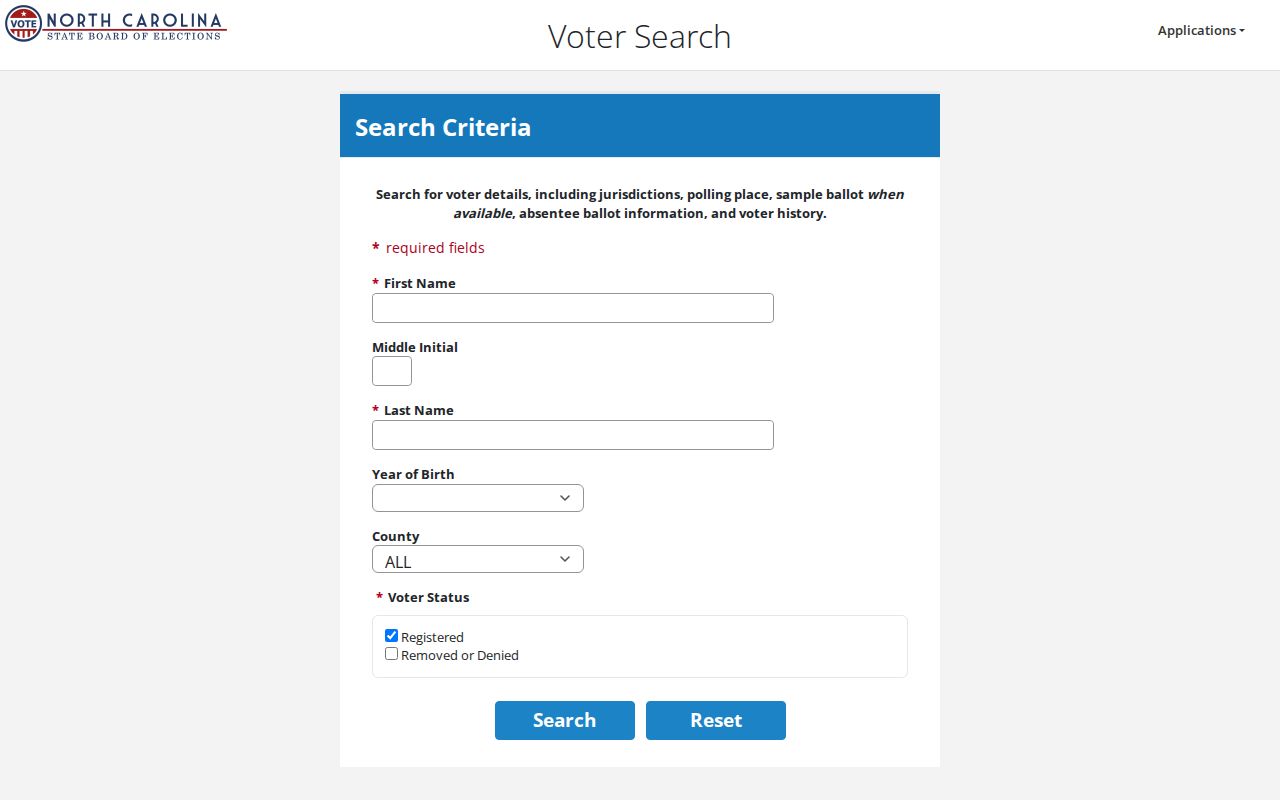
The screen reinforces why a surname and Randolph County are the best first pair, with other fields used only to separate similar names.
Read an Asheboro Voter Record
A public result joins identity, registration, and election-geography fields. It can distinguish two Asheboro residents with the same name by year of birth, precinct, status, or registration date. Residential and mailing addresses appear when the record is not protected. District fields may include congressional, North Carolina Senate, North Carolina House, county commissioner, municipal, and other applicable areas. Sample ballot links may also appear during an election.
| Record field | What it tells you |
|---|---|
| Name and status | The registered name and current active, inactive, or other listed status. |
| County and address | Randolph County plus residential or mailing address, unless the address is protected. |
| Registration details | Registration date and party affiliation or unaffiliated status. |
| Precinct and polling place | The local voting assignment tied to the record. |
| Districts | The federal, state, county, municipal, and other districts that apply. |
| Participation history | Election and method records, but never candidates or issues selected. |
An NCID or state voter identifier can appear in downloadable public data. It is a database key, not a driver-license or Social Security number. Use the file layout that comes with the data before interpreting any short code. That small step prevents a district code, method code, or status field from being mistaken for plain text.
Private Fields in Asheboro Voter Records
North Carolina draws a firm line between public voter fields and personal identifiers. G.S. 163-82.10(a1) makes full or partial Social Security numbers, dates of birth, registration-agency identity, email addresses, voter-ID photos or copies, and driver-license numbers confidential. A signature may be viewed under the statute, but it may not be copied or traced.
Confidential by North Carolina law. A public Asheboro voter record does not open protected identifiers, full birth dates, private email, ID documents, or a qualifying protected residence address.
County and precinct lists may be selected by affiliation, gender, race, age, registration date, precinct or code, districts, and voter history. The list itself cannot include date of birth, even when an age range was used to select records. Public access therefore supports legitimate civic research without turning the registration system into a source of secret ID data.
Asheboro Voter History Has Limits
A participation row says that the election system recorded the person in a given election. It may also show election-day, early, or absentee method codes when the matching file layout defines them. It never reveals a vote for a person or issue. North Carolina ballot secrecy is separate from the public record of participation, and knowing disclosure of how an individual voted is a Class 1 misdemeanor under G.S. 163-165.1.
Do not read too much into a missing row. The voter may have registered later, moved between counties, or fallen outside the available history. A database change can also affect older rows. An unaffiliated voter may choose an allowed party primary in North Carolina, so a primary-history entry does not by itself show a lasting change in affiliation.
District and precinct values belong to the snapshot date. Redistricting and municipal boundary changes can alter those fields even if the resident stays at the same address.
Note: Participation history records whether someone took part, never the candidate, question, or position marked on a secret ballot.
Download Asheboro Voter Rolls
The NCSBE Results & Data collection publishes registration and voter-history files with layouts and code documentation. These free downloads are the practical route for a dated group view. Files are machine-readable, can be large, and may be packaged as ZIP or CSV data. Filter for county code 76, Randolph, then use municipality, precinct, or district fields to isolate the Asheboro area.
Registration and participation history are separate datasets. Join them only with the voter identifier documented in the matching layout. Do not join on name or address alone, since two people can share those values and a person’s address can change. Record the file date as well. A bulk file is a snapshot, not a live promise that every field remains current.
The state registration data page presents the available data products and their supporting documentation.
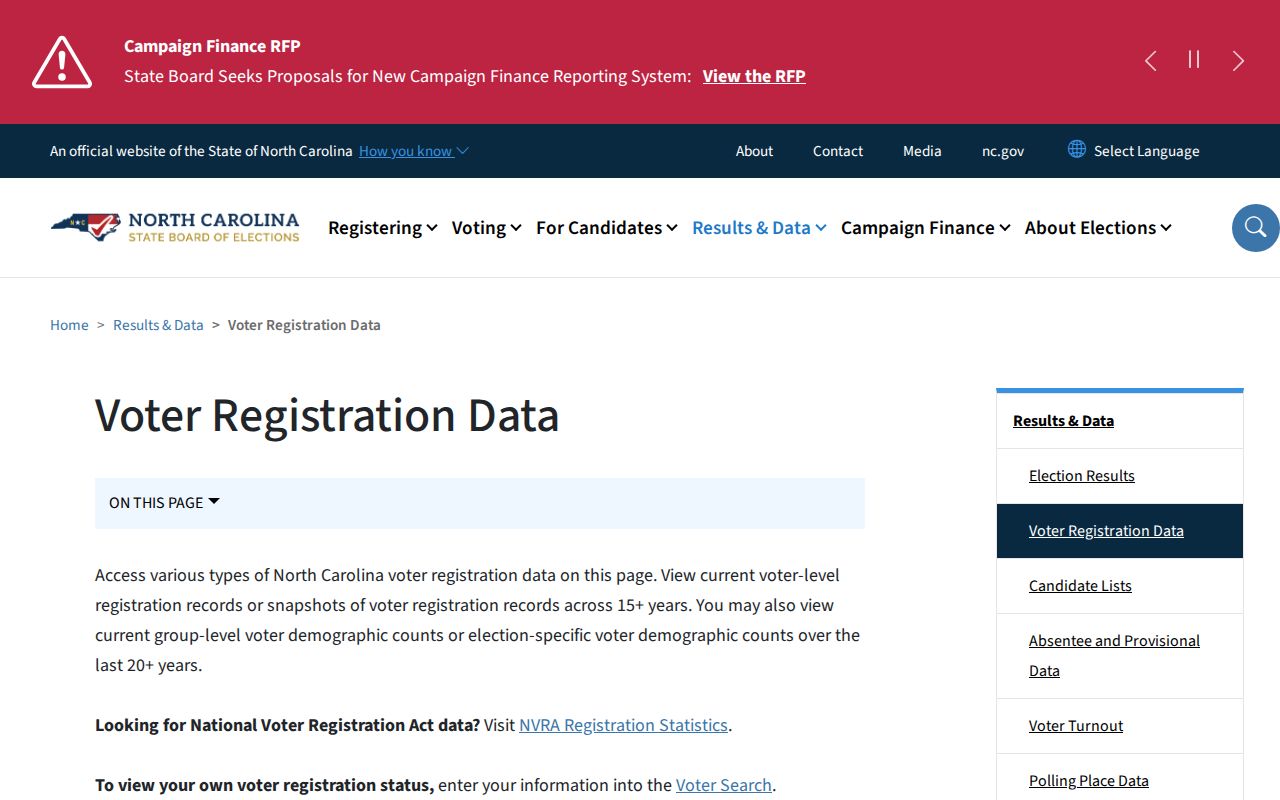
The download view separates registration data from history data, a distinction that should remain intact during any Randolph County analysis.
Request an Asheboro Voter File
Published files meet many needs, but a custom Randolph County list may call for a written request. Under G.S. 163-82.10(c), any person may request county or precinct lists. G.S. 163-82.13 also permits the State Board to sell statewide or selective copies to public or private persons and organizations at the actual cost of preparation. No fixed dollar amount was found for a custom extraction, so request an estimate before work begins.
- State the requester name, organization if any, mailing or email address, phone, and the preferred delivery route.
- Define the geography, such as Randolph County, Asheboro, named precincts, or districts. Add a clear as-of date.
- List the selection criteria and fields needed. Available selection may include party, gender, race, age, registration date, precinct, district, and history.
- Ask for CSV or another available file type, the matching layout, and an actual-cost estimate for custom work.
- Sign and date the written request when required, then retain the response and data snapshot together.
Send a county-focused request to Randolph Elections or use the State Board for statewide and multicounty work. Political party chairs receive certain copies without charge under the statute, but ordinary public requests remain available. A general public-record demand should not seek fields that voter law makes confidential.
Asheboro Voter Status Changes
Active, inactive, and cancelled do not mean the same thing. An inactive status does not itself make a voter ineligible. North Carolina list maintenance under G.S. 163-82.14 and federal NVRA processes can use death, felony conviction, move information, and confirmation mail. Cancellation cannot rest only on a failure to vote. A Randolph County registration stays in place until a move, authorized cancellation, or another statutory event changes it.
An Asheboro voter who moves within Randolph County should update the address so precinct and district assignments stay correct. A move outside the county can lead to cancellation or transfer. When a lookup seems wrong, contact the county board instead of treating a stale online result as final. The board can review the current system and explain the proper correction route.
Protect Asheboro Voter Addresses
G.S. 163-82.10(d) allows a qualifying voter to keep the residence address confidential. The person must present a qualifying protective order or a current Address Confidentiality Program card with the required signed safety statement. The real address remains available for election administration and limited court or law-enforcement access, while the name, precinct, and other nonconfidential registration data stay public.
The North Carolina Address Confidentiality Program provides a substitute address and mail forwarding for qualifying survivors. A protected voter should contact Randolph Elections for the election-record process. A general records request is not the way to make the correction.
Use voter data lawfully. Public access does not permit stalking, threats, repeated harassment, or attempts to expose a protected person. Report suspected voter-data misuse to Randolph Elections or NCSBE.
Asheboro Voter Help at the Counter
The Randolph County Board of Elections is at 1457 N. Fayetteville Street, Asheboro, NC 27203. Call 336-318-6900, fax 336-318-6903, or email elections@RandolphCountyNC.gov. Staff can inspect the current registration system, clarify a precinct or district, and accept a targeted county list request. Give the office a defined scope, snapshot date, requested fields, selection rules, and delivery format.
Geographic questions may need a second channel. Randolph Public GIS and the county’s downloadable GIS data include precinct and election layers. Those tools answer where a boundary falls, while the name lookup answers which assignment is tied to a person’s current record. The State Board is the better contact for statewide files, multiple counties, and questions about published layouts.
Note: Email requests should define the file and snapshot date, then ask for an estimate if custom extraction or programming is needed.
Verify Asheboro Voter Totals
County registration totals are useful only when the date is sound. During research, the Randolph Elections page displayed totals labeled with a future date. That apparent publishing defect makes the figures unfit for release. A clean approach is to use a clearly dated NCSBE registration snapshot, preserve its layout, and state the file date with any count.
Totals can also shift as registrations, moves, removals, and district changes are processed. Do not combine counts from pages with different dates. For Asheboro-only work, document how municipality or precinct fields were used, since Randolph County totals include residents outside the city. This small audit trail makes a count repeatable and prevents a countywide number from being mislabeled as a city number.
Trace Historic Asheboro Voter Records
Current voter registration data does not prove where someone lived during an older election. Historical poll books and registration registers may survive, but no complete online year list was located for Randolph County. Start with Randolph Elections, then ask the State Archives about county election series, board minutes, canvass files, abstracts, and any surviving named poll books. Election returns are generally easier to find than lists of individual participants.
The State Archives Randolph County inventory is an entry point for older county material. Randolph Room newspapers can add election notices, candidates, officeholders, and reported results. Use those sources as context, not as proof that a named resident cast a ballot. The county was created in 1779 from Guilford County, so earlier research must follow the parent jurisdiction rather than assume an Asheboro series existed.
Ask for a precise record series and date range. If no poll book survives, pair election returns with tax lists, deeds, directories, newspapers, and census material to establish residence and civic context without inventing participation.