
Explore Asheboro People Directories
Asheboro people directories fall into two broad groups. Current institutional lists identify people in an official, school, business, or licensed role. Record indexes and historical collections connect a name to a transaction, parcel, case, publication, or past address. The distinction matters. A school entry is a work contact, a deed entry records a dated legal act, and a city directory may describe a household that moved long ago.
| Asheboro directory | People represented | Source keeper | Best access route |
|---|---|---|---|
| City department pages | Municipal leaders and staff | City of Asheboro | Online by department |
| Randolph school staff list | District and school personnel | Randolph County School System | Name and department filters |
| N.C. employee directory | State agency employees | North Carolina | Name and agency search |
| Recorded-document indexes | Grantors, grantees, owners, and case parties | County and state offices | Online portal or office terminal |
| License and entity tools | Licensees, entities, and registered agents | State boards and Secretary of State | Board-specific online search |
| Randolph Room collections | Past residents, relatives, and community members | Randolph County Public Library | Catalog check and in-person research |
Choose the list that matches the relationship being checked. Start with a department directory for a public official, the school system for an educator, a licensing board for a regulated professional, or the Randolph Room for a past resident. When only an address is known, a reverse directory or the property roll has more value than an alphabetical staff list.
Navigate Asheboro Government Directories
The City of Asheboro department index is the main route to municipal contacts. The city does not present a rich, unified name-search tool. Department pages instead identify leaders, titles, office numbers, and contact links. Council, board, and commission rosters list elected and appointed members. Minutes can preserve earlier service, attendance, recusals, applicants, and speakers after a current roster changes.
Randolph County uses department pages and its county directory for officials and staff. State workers can be found through the North Carolina employee directory. Search by first or middle name, last name, or agency. The result is an organizational contact, not proof of a home address or private role.
The official state directory screen shows how the search is framed:
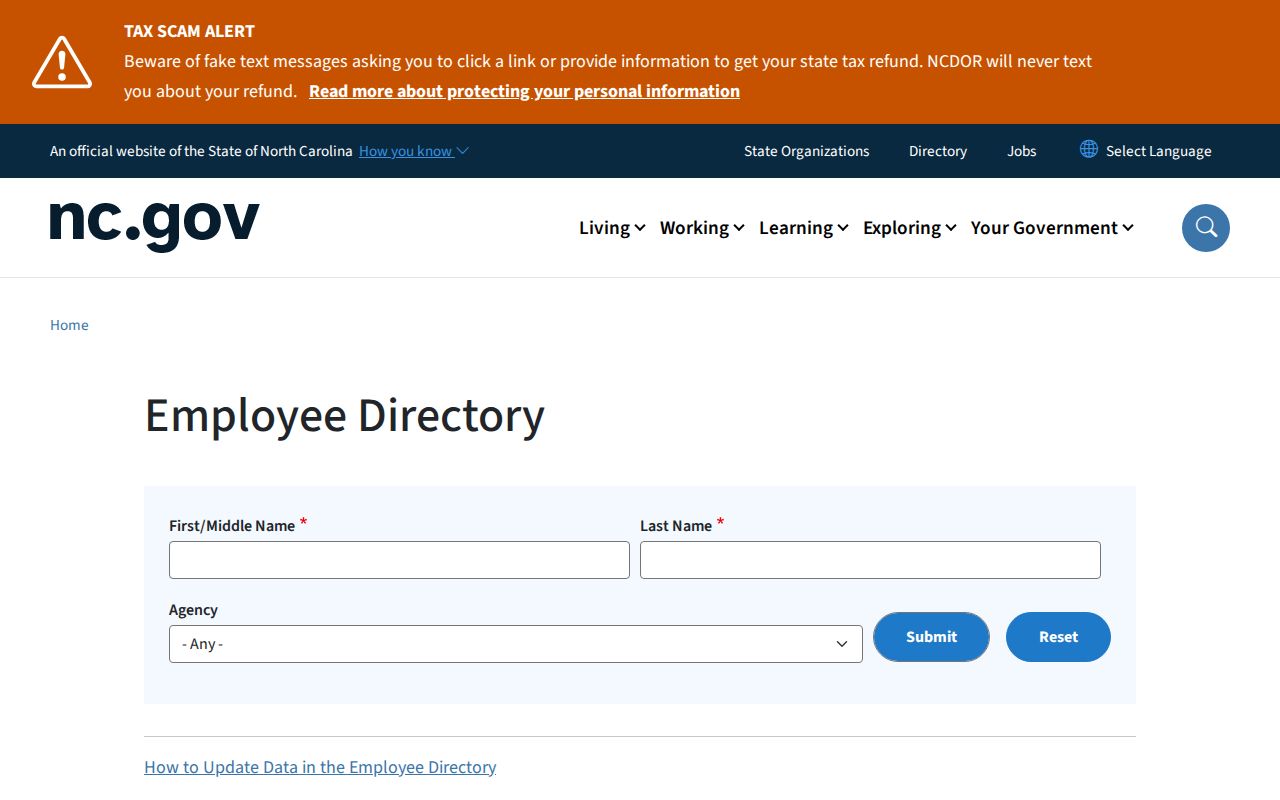
Agency filtering is useful when a common name produces many matches. If no entry appears, call the department’s published main number, check a board roster, or request an existing staff roster from the office that maintains it.
| Full name | Shown as the public organizational identity |
|---|---|
| Title or unit | Explains the person’s government role |
| Work phone | May be direct, an extension, or a department line |
| Work email | Appears when the agency publishes it |
| Office | May identify an agency or public building |
Search Asheboro School Directories
The Randolph County School System staff directory filters by staff name and department. Its department control includes central functions such as the Superintendent’s Office, Curriculum and Instruction, Operations, Budget and Finance, and Human Resources. Results run across multiple pages. A typical entry can show a portrait, full name, title, department, direct phone or extension, and a Send Message control.
| Search control | Input type | How it narrows the directory |
|---|---|---|
| Search | Name text | Filters staff entries by name |
| Select Departments | Dropdown | Restricts results to an organizational unit |
| Page number | Pagination | Moves through the full result set |
| Send Message | Entry action | Opens the published contact route |
Asheboro City Schools is a separate school system, so an address within the city may require its own district and school pages rather than the county list. Randolph Community College faculty pages and library holdings add college personnel, catalogs, newsletters, and yearbooks. Alumni lists may be private or access-controlled and should never be assumed open.
Note: A school directory supplies work contact details; old yearbooks need a second source because scanning errors and later name changes can mislead.
Use Asheboro Record Directories
Several public-record tools behave like people directories even though each was created for another purpose. The Register of Deeds name index lists grantors and grantees in recorded instruments. Randolph Public GIS offers owner autocomplete and then opens parcel details. The N.C. voter lookup lists public registration fields, while eCourts Portal lists parties and their roles in public cases. None is a general resident list.
- Grantor or grantee
- A person or entity transferring or receiving an interest in a recorded instrument.
- Situs address
- The physical location of a parcel, which may differ from the owner’s mailing address.
- Case party
- A named participant whose role may be plaintiff, defendant, decedent, heir, creditor, or another status.
- Index
- A finding tool that points to a source document; the index alone may not give full context.
The meaning must travel with the name. A deed party took part in a dated transfer. A GIS owner is tied to an assessment record, not necessarily occupancy. A voter address reflects election registration and can be protected. A court result requires the party role and file context. The access-law and copy rules belong with the custodian, as detailed under Asheboro public records.
Check Asheboro Safety Directories
North Carolina maintains official custody and registry tools with narrow public-safety purposes. The N.C. Department of Adult Correction search covers state prison offenders, probationers, and parolees back to 1972, but it excludes the Randolph County jail. NC SAVAN is the better fallback for current county custody and notification enrollment because no verified county-hosted inmate roster was found.
The N.C. State Bureau of Investigation registry supports name, address, map, radius, and registration searches. Its result can include a photograph, physical description, registered location, and offense information:
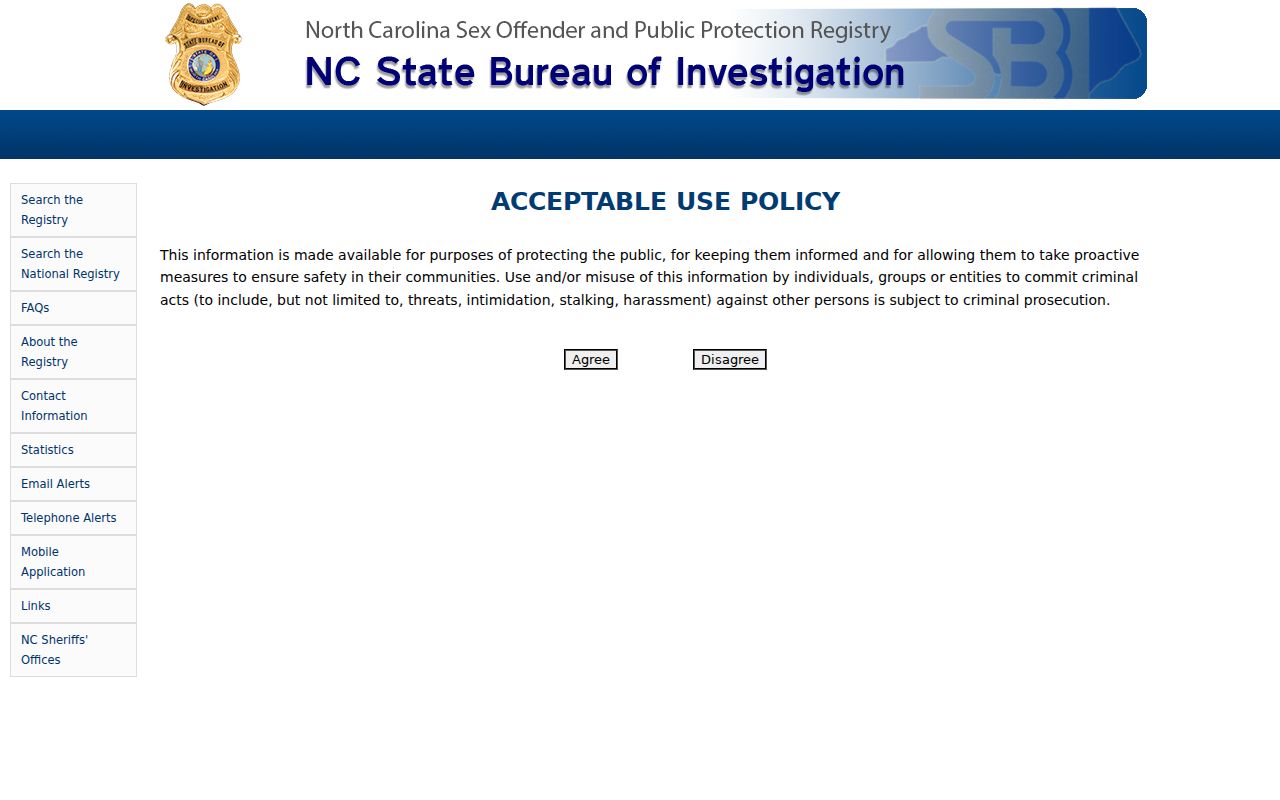
A registry address is a reported registration location and may change. Confirm current information with the SBI or local sheriff. The data is for public protection and may not be used to stalk, threaten, or harass anyone.
Browse Asheboro Professional Directories
North Carolina licenses professions through separate boards. The state license portal list identifies the right regulator, then the issuing board’s verification tool supplies the authoritative status. Useful directories include the Medical Board, Board of Nursing, State Bar, General Contractors board, Real Estate Commission, Cosmetic Art Examiners, and NCTracks practitioner search.
| Directory type | Useful search keys | What a result can establish |
|---|---|---|
| Professional board | Name, license, location | Credential type, status, and public action links |
| NCTracks | NPI, license, last and first name | Enrolled practitioner record |
| Secretary of State | Entity or registered-agent name | Legal name, status, formation, agent, filings |
| Assumed-name filing | Business or party name | County-recorded trade-name connection |
| ABC permit search | Permittee or permit | Business, location, and permit |
The Secretary of State business search should be read with care. A registered agent may be a service company rather than an owner. Annual reports and Randolph assumed-name filings can identify principals more clearly. A practice or business address is also not proof of residence.
No Modern Asheboro Phone Directory
No authoritative government white-pages directory for current private residents was located. Printed telephone and city directories in the Randolph Room are the responsible historical channel. Ask library staff which volumes contain reverse telephone or street sections, since the published genealogy guide confirms city directories but does not give a complete year-by-year shelf inventory.
Private alumni, church, congregation, and neighborhood rosters are not made public merely because they contain Asheboro names. Use public institutional contacts, published historical materials, and records created for public business. When a current private number is not in an official source, respect that gap.
Read Asheboro Obituary Directories
The Randolph Room bibliography documents a Courier Newspaper Obituary Index for 1903 through 1929. That focused name directory can connect a decedent to maiden names, relatives, churches, cemeteries, occupations, and former homes. It pairs well with county vital records and estate files, but the original notice should be checked because an index entry is only a pointer.
Newspaper continuity is unusually strong. State Archives microfilm includes an Asheboro Courier issue from 1881, Courier runs from 1884 through 1891 and 1903 through 1940, and Courier-Tribune runs from 1940 through 2017 under changing publication schedules. The files can reveal reunions, civic rosters, addresses, marriages, and community ties that never reached an online public portal.
Note: Newspaper claims add context, but a court order, deed, certificate, or other originating record remains stronger proof of an official event.
Find Asheboro Community Directories
Yearbooks, church histories, cemetery surveys, Friends meeting minutes, and college collections work as community directories. Randolph Community College catalogs and institutional archives can identify students and faculty; its library and DigitalNC are the starting contacts. School yearbooks can restore a class connection when a modern school directory lists only current staff.
Friends records have special value in Randolph County. Meeting minutes may record marriages, disownments, removal certificates, and moves. Cemetery transcriptions, funeral-home notices, and church registers can then link a person to relatives and burial details. The Randolph Room’s surname and vertical files may contain donated clippings, charts, letters, or notes. Treat those as leads and cite the original record whenever one can be found.
Trace Historical Asheboro Directories
The Randolph Room genealogy guide confirms city directories, old maps, census material, tax lists, deeds, wills, school histories, cemetery records, and newspaper resources. A local landmark report cites Asheboro city directories from 1980 through 1998, but the full range of volumes remains unverified. Call the library before travel and ask for exact titles, publishers, years, and reverse sections.
City and Reverse Directories
At least a 1980-1998 run is documented in local research use. Confirm the complete shelf list.
Randolph Room Maps
An 1843 Asheboro town map and mill or farm surveys can translate older place descriptions.
Newspaper Microfilm
Courier-related title periods extend from 1881 through 2017 in the Archives inventory.
Use a directory edition as a dated snapshot. Check its alphabetical section for a name and spouse, then its street or telephone section for other occupants. Compare the result with a census, deed, tax list, obituary, or newspaper. Occupant and owner may differ. The missing 1890 federal population census makes these directories, deeds, tax lists, and papers especially useful.
Randolph County was created in 1779 from Guilford County, so earlier research must move into parent jurisdictions. The State Archives also preserves less common name lists, including an 1849 Asheboro commissioner minute, early liquor licenses, naturalizations, pensions, and a confiscated-property inventory. These records turn the historical directory search into more than a simple address lookup.