
Which Asheboro Records Are Open
North Carolina law starts with broad access to material made or received in public business. Record-specific laws then set limits. In Asheboro, the right keeper depends on the file. The Register of Deeds holds land instruments and county vital events. The Clerk of Superior Court keeps trial-court, estate, and special-proceeding files. Tax and GIS staff maintain parcel facts, while police and the Sheriff answer for their own incident or custody material.
| Asheboro record trail | Official keeper | Online reach | How access works |
|---|---|---|---|
| Deeds, liens, plats | Randolph Register of Deeds | Deeds from 1986; plats from Book 1 | Web index and images; office books and help for older work |
| Civil, criminal, estates | Randolph Clerk of Superior Court | Statewide eCourts Portal | Portal summary; courthouse terminal and file inspection |
| Parcel and tax facts | Randolph Tax Department and GIS | Current Public GIS | Free viewer; direct Tax Department request |
| Birth, death, marriage | Register of Deeds or N.C. Vital Records | Local index and order channels | Open uncertified inspection; certified-copy eligibility applies |
| Custody and corrections | Sheriff, NCDAC, SBI | State search tools | Online state data; call or request for county custody |
| Police incidents | Asheboro Police or Sheriff | No complete local case index documented | Request the public fields by incident details |
Open status does not mean every page is on the web. Sealed and expunged cases, juvenile files, adoption material, protected addresses, confidential voter fields, and DMV personal data stay outside ordinary inspection. Investigative and personnel files have their own statutory splits. A missing portal result may point to an offline file, a different custodian, or a lawful restriction.
Asheboro Deed Records Since 1986
The Randolph County real-estate records service provides index data and images from January 1, 1986 to the present. Image coverage begins at Book 1173, page 853. Historical images and indexes cover Books 1071 through 1172, while plats reach back to Book 1. That online line is not the start of county land records. For older deeds, use the historical books, ask the office about microfilm or transferred material, and check archival or FamilySearch holdings.
| Portal field | Input | Best use | Format note |
|---|---|---|---|
| Name | Text | Grantor or grantee search | Use Advanced Search “contains” |
| Party role | Menu | Limit transfer side | Grantor, grantee, or both where offered |
| Book and page | Number pair | Open a known instrument | Use the exact deed reference |
| Subdivision | Text | Find plats and lot instruments | Search the recorded subdivision name |
| Date range | Date pair | Narrow common names | Uses recorded or index dates |
| Document type | Menu | Limit results | Choose the needed instrument class |
Older entries may abbreviate Charles, Robert, Thomas, and William as Chas, Robt, Thos, and Wm, especially from 1986 through 1993. Try both forms. An “E” after a GIS book reference means an estate book kept by the Clerk, not an ordinary deed book at the Register. That small suffix prevents a wasted request at the wrong counter.
Note: Read the recorded image before drawing a legal conclusion because an index is a finding aid, not the full instrument.
Asheboro Court Records After eCourts
Randolph County joined Enterprise Justice on October 14, 2024. The N.C. eCourts Portal now supports anonymous statewide searches by case number or party and business name. Filters include location, case category, status, filing dates, and party criteria. A last-name wildcard needs at least three characters before the asterisk. The result can show parties, roles, case type, status, events, hearings, dispositions, and some financial data.
The Portal is a summary and search route, not always the complete court file. Public self-service terminals at the courthouse add criminal searches by defendant, case number, victim, or witness and also show civil, estate, and special-proceeding information. The Clerk keeps the actual paper or electronic file in the county where it was filed. Ask staff which documents may be inspected and whether an archived file needs retrieval.
Randolph Superior and District Courts serve Asheboro; there is no separate municipal court. Federal matters are handled by the Middle District of North Carolina and searched through PACER, with the federal clerk or National Archives as older-file fallbacks. Converted pre-launch events may display a midnight timestamp, which reflects migration rather than the true hour of an old filing.
Asheboro Property Records Fields
The Randolph Public GIS searches owner, location address, property description, or a 10-digit parcel identifier called a PIN. A selected parcel may show the owner, mailing address, situs address, acreage, values, deed book and page, legal description, municipality, tax districts, zoning, precinct, and other map layers. “Situs” means where the land sits. The mailing address is where tax mail goes, and it may belong to a nonoccupant owner.
Use the viewer for current context, then treat the recorded deed or plat as the authority on title and legal description. A street name can return all matching parcels. Community Info helps determine whether an Asheboro postal address is actually within city limits. When a historic tax year matters, contact the Tax Department for the assessment or parcel record from that year rather than assuming the current map preserves it.
Permit and code files form a separate address trail. City properties may appear in Asheboro’s iWorQ portal; other files can be requested from the city department with an address, PIN, permit number, and rough date. County inspections cover sites outside municipal jurisdiction, so the GIS municipality result should come first.
Asheboro Vital Records Copy Rules
Randolph County birth and death events and marriage licenses are kept by the Register of Deeds. An uncertified copy may be inspected under G.S. 130A-99, but it is not a legal certificate. Under G.S. 130A-93(c), a certified copy is limited to the subject, listed close or step relatives, an authorized agent or legal representative, or someone who establishes a personal or property right. A current government photo ID is required.
The county offers in-person, mail, and linked online-vendor channels. For mail, send the signed application, a $10 certified check or money order, a self-addressed stamped envelope, and a copy of valid photo ID to P.O. Box 4458, Asheboro, NC 27204. N.C. Vital Records is the statewide route for birth, death, marriage, divorce, amendment, and case-management needs.
North Carolina has no simple rule that opens every birth or death certificate after a fixed number of years. Adoption files are sealed under Chapter 48. For early family research, use lawful indexes, marriage and estate files, church and cemetery material, newspapers, delayed births, and archival collections. Statewide birth and death registration generally starts in 1913.
Asheboro Public Records Offices
The county-seat location puts the main land and court desks near central Asheboro, but they are not interchangeable. Bring the file identifier each office uses. Deed staff work best with a name, approximate year, instrument type, or book and page. Court staff need the full case number and division. Tax staff can use a PIN, owner spelling, parcel address, and tax year.
Randolph Register of Deeds
158 Worth Street, Asheboro
Mail: P.O. Box 4458, Asheboro, NC 27204
336-318-6960
Randolph Clerk of Superior Court
176 East Salisbury Street, Asheboro, NC
336-328-3100
Randolph Tax Department and GIS
Parcel, assessment, and map records
336-318-6500
Recording at the Register stops after 4:30 p.m. The courthouse main number is 336-328-3000. Phone calls can confirm the right desk and file route, but certified copies still require the office’s formal order and fee process.
Asheboro Custody and Police Records
No verified Randolph County government-hosted current inmate roster was found. For local custody, use NC SAVAN and call the Randolph County Detention Center or Sheriff. The state correction search does not include a person held only in the county jail. For a city police record, supply the incident number, date, time, location, and involved name so the custodian can locate the right file.
The official N.C. offender search accepts a name or offender ID and covers prison offenders, probationers, and parolees back to 1972. Its live search screen appears below.
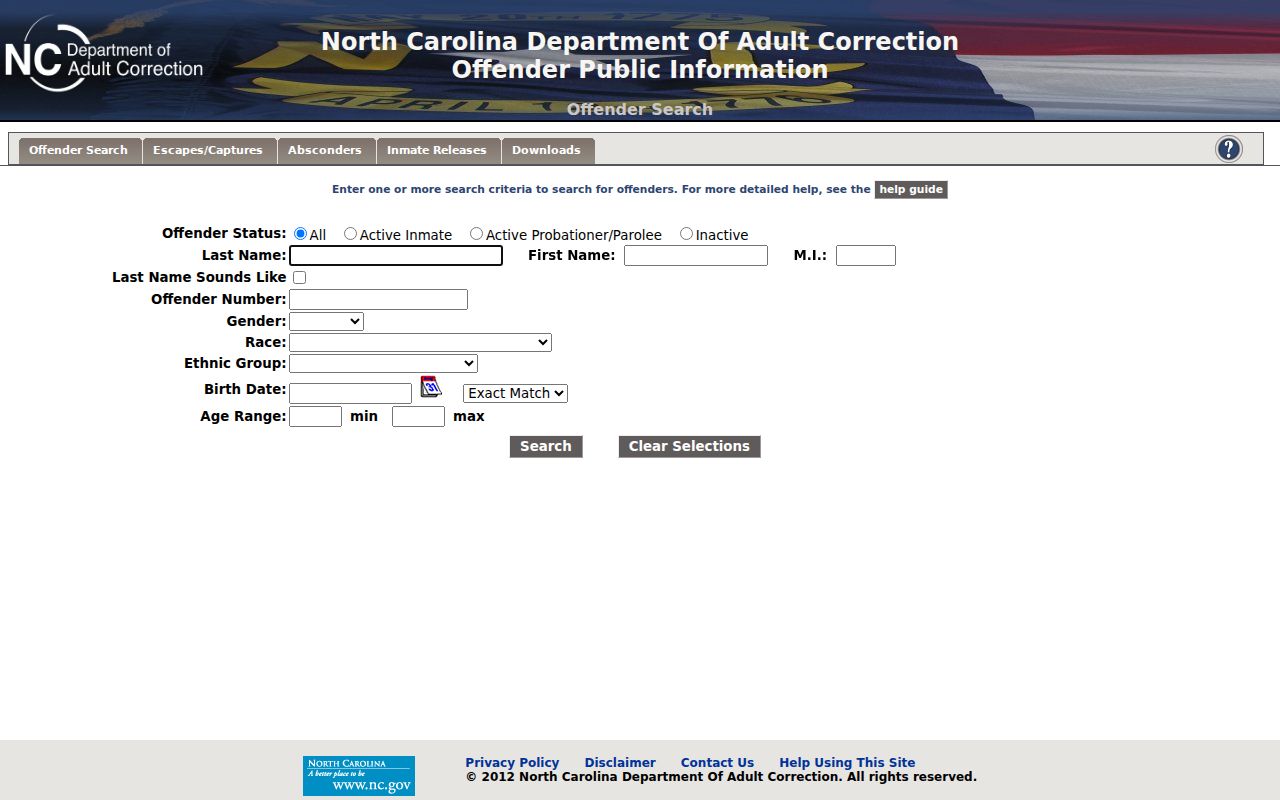
The form’s state scope and long coverage make it useful for corrections history, while a direct county channel remains essential for present local detention.
G.S. 132-1.4 protects criminal-investigation material but lists incident and arrest information that remains open. Ask for those public fields and any segregable portion, meaning a part that can be released after exempt details are removed. Registry information is for personal safety. It must not be used to threaten or harass a listed person.
Compare Asheboro Records Copy Costs
Inspection can save money. Review an index or file first, then order only the pages that must carry an official seal. Randolph’s fee schedule makes a plain deed copy far less costly than a certified instrument. Vital pricing also changes by route because the county serves local events while the state performs a broader search.
| Copy or service | Randolph County cost | State alternative | Key difference |
|---|---|---|---|
| Uncertified deed page | $0.25 per page | Not applicable | Research copy, no seal |
| Certified deed | $5 first page, $2 each added page | Not applicable | Official certification |
| Plat | $2 at 18×24; $3 at 24×36 | Not applicable | Size controls price |
| Vital certificate | $10 for a Randolph event | $24 for one three-year search and one copy | State search fee is nonrefundable |
Chapter 132 lets an agency charge no more than actual reproduction cost for uncertified copies. Extensive clerical, IT, or supervisory work may support a reasonable special-service charge. Ask for an estimate before work begins. A vendor used for a state vital order may add its own fee, so compare the official routes before submitting payment.
Protected Asheboro Records Boundaries
Several records never become open merely because a broad request cites Chapter 132. Juvenile, adoption, sealed, and expunged court matters follow their own laws. DMV personal data is restricted by the federal Driver’s Privacy Protection Act and state law. Certified vital copies require a listed relationship or legal basis. Voter birth dates, identification numbers, email addresses, registration agencies, and ID images are confidential.
The N.C. Address Confidentiality Program under Chapter 15C gives qualifying survivors a substitute address and mail forwarding. A qualifying voter may also protect a residence address under G.S. 163-82.10(d). These protections do not necessarily erase older filings. If a withheld file contains both closed and open material, ask the custodian for the specific exemption and for nonexempt portions that can be separated.
Lawful personal use. Open access does not grant permission to stalk, threaten, or repeatedly harass anyone. North Carolina criminal law still applies to misuse.
Asheboro Records Redaction and Alerts
Randolph County accepts requests to remove sensitive identifiers from online recorded-document images under G.S. 132-1.8. Covered details include Social Security, taxpayer, driver or state ID, passport, bank or card numbers, and PINs or passwords. The written request may be sent by mail, fax, electronic transmission, or in person. It must identify the data, document, and exact spot. There is no fee.
The county also offers free property-fraud notification. Since November 16, 2020, an enrollee may monitor up to five names and receive an email after a matching filing. The alert does not validate or block a document. Confirm an unexpected notice with the Register at 336-318-6960. An unauthorized redaction request may draw an infraction of up to $500 per violation.
Note: A source-record correction or redaction does more than removing a copied listing elsewhere because later users return to the custodian’s file.
Request Asheboro Public Records
North Carolina Public Records Law, Chapter 132, allows any person to request an existing government record without stating a reason. G.S. 132-6 calls for access at reasonable times and copies “as promptly as possible.” It sets no fixed general number of response days. G.S. 132-6.2 permits a medium the agency can provide, including electronic form, and a choice between certified and uncertified copies.
- Choose the custodian. Send land files to the Register, court files to the Clerk, parcel files to Tax or GIS, and incident files to the creating police or Sheriff office.
- Define the record. Give names and aliases, a date span, record type, and any case number, PIN, incident number, or book and page.
- Use the proper channel. Search a portal, inspect at the counter, email the department, mail a form, or use Asheboro iWorQ for city requests where it fits.
- Choose the format. Ask for existing electronic data in its native searchable form when the agency can supply it. The law does not require creation of a new record.
- Confirm the price. Request an estimate for copies, certification, or any special service before staff begin costly work.
- Address withheld parts. Ask for the statute behind each denial or redaction and request all portions that can lawfully be separated.
- Escalate if needed. Follow up with the department head or counsel, seek available mediation, or consider the civil remedy in G.S. 132-9.
No universal form is mandatory when a clear request identifies the record. Specialized systems still govern court, election, and vital material. A narrow request for a known file is more useful than asking an office to research a person. Keep the sent request, response, estimate, and the date each step occurred.
Read Asheboro Records Terms
Office language can change what is ordered and what it proves. These terms keep an index hit, an official copy, and a legal restriction from being treated as the same thing.
- Index
- A list used to locate a record. It may show names, dates, type, and a file reference without reproducing the full document.
- Image
- A scan of the recorded instrument. It can contain signatures, legal descriptions, addresses, and prior references omitted from the index.
- Certified copy
- A copy authenticated by the keeper as an official reproduction. Certification does not make every statement in the old file current.
- Custodian
- The agency or official responsible for the requested record and its release decision.
- Exemption
- A statute that closes a record or field that would otherwise fall within the broad access law.
Match names with dates and identifiers before deciding that two entries refer to one person. A case number, instrument, PIN, or other unique official reference carries more weight than a same-name search result. Negative results are weak evidence because spellings, older systems, offline books, and county boundaries can all change where an entry appears.